|
35000 cubic meters of toxic trashes of 'Zamingaysi' were seen in
'Shadegan’ Wetland
In 25th of November 2004
the Earth Watchers Center (EWC) reported the purge of Zamingaysi
of Abadan and the spread of toxic materials in the city.
Afterwards, for getting more information, from 23 to 26th of
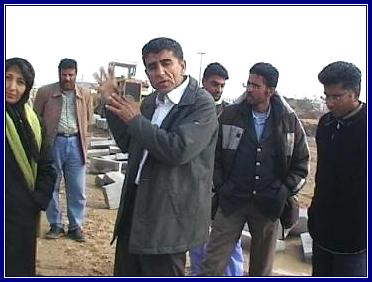
December 2004 , EWC went to Abadan to visit Zamingaysi and to see
the processes of purge and the current location of expulsion of the
trashes and they visited some administrators of the city such as the
mayor of Abadan , the head of environment organization, and experts
of sanitation of the oil company, contractors and supervisors of
boulevard project,…. This meeting illuminated new aspects of the
problem the summery of whom is coming here:

December
2004
In the meeting with Dr.
Bahreini, the mayor of Abadan , the representative of EWC discusses
about imperfect purge and the likely population of schools around
the Gaysi . In addition, they criticized for not choosing a suitable
place and expulsion the toxic trashes in Shadegan. With acceptance
the critiques and the implicit confirmation of the previous report
of EWC, the mayor of Abadan had a letter written to administrators
of Abadan and with implication to the enforcement and complementary
of the excavation and purge project, ordered the administrators of
refinery to continue the process. In the mentioned letter it is
written that in case of defiance, they are responsible and should
accept the consequences.


December
2004
The important points in
this meeting:
The entire determined
budget (500000 $) was mostly for the construction of boulevard (with
dimensions of 550 and 65 meters) out of which is 3500 million Rials
(about 400000$) for the expense of purge of the earth from oily
trashes.
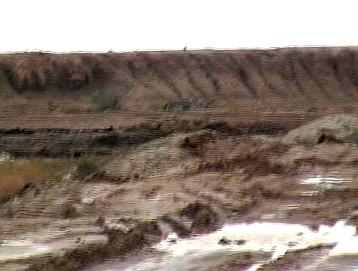
The toxic trashes expelled
from the boulevard were 35000 cubic meters which are garnered
compactly with Lime and cobblestone in a place called 'trash hole'
(the western part of Shadegan wetland, 25th km of the Abadan -Mahshar
road). Unfortunately the analysis of these materials that ought to be
the first step before any action hasn't been done yet by any
responsible such as the mayor, the refinery and the environment
organization and still there is no program for recognition the
compounds of these materials!
The expulsion of toxic
materials is just limited to boulevard region, and the north and south
of the boulevard, the Zamingaysi area, where there are several
schools, hasn't been purged and is likely to be populated of these
materials. Just by geotechnical experiments can be determined the kind
and extent of the toxic materials buried in this area and the
dangerous effects of the spread gases on the students of these
schools.
Quoting from the experts
of refinery, these materials are mostly acidic including sulfur,
sulfur compounds and heavy metals like vanadium (which can be
deposited). In the alkalization unit, these materials convert to
petrol and leave acid. The left acid also includes aromatic materials
which cause cancer. Before the Islamic Revolution (1979) these
materials used to be burnt or buried in a place where always used to
stank.

December
2004

December
2004

December
2004
December
2004
Suggestion:
According to the fact that
the purge process was just limited to the area of construction of
boulevard, it is necessary to perform an extensive geotechnical
process up to the Zamingaysi areas where citizens of Abadan know
well and also in the schools constructed in these areas.
The chemical compounds and
also the short and long term effects of these materials on the human
being and the environment should be determined and necessary actions
should be done as soon as possible.
According to the fact that
the Shadegan wetland is one of the most important international
wetlands
of Iran, 35000 cubic meters of toxic trashes of Gaysi should be
expeled and the necessary actions for neutralization should be done as
soon as possible.
According to the important
responsibility of the environment organization, it should seriously
supervise all the actions of recognition, purge and annihilation of
toxic trashes of Zamingaysi .


Footnote:
Shadegan wetland with the
area of 400000 hectare is placed 40 km from Ahvaz. This wetland faces
Ahvaz, Khordorgh and Shadegan from north, faces Ahvaz-Abadan
asphalted road from west, faces Bahmanshir River and Persian Gulf
from south and faces khormoosa from east. One of the dangers that
threat this international wetland is the crossing of the Abadan
-Sarband or Abadan -Mahshar road from it. It should be mentioned that
in the visitation of this region, all the trashes of Abadan were
completely visible in both sides of this road from 8 kilometers to
Abadan . The garner of these toxic trashes has raised this population
much more. Not accomplishing necessary actions, the wetland will face
more environmental danger. Unfortunately, the environment organization
has done nothing significantly and the extent and quality of the
wetland decrease everyday. In addition to environmental values of this
wetland (including botanical and animal), it has other important
functions like the harness of floods above the wetland, decrease of
destructive effects of flood and prevention from erosion of coasts
from Khormoosa to Abadan .
e) Shadegan Marshes and
mudflats of Khor-al Amaya & Khor Musa Ramsar site
Introduction
68. Shadegan Marshes were
included on the Montreux Record on 16 June 1993 because of the effects
of chemical pollution which resulted from the Iran-Iraq war. Neither
the 1992 mission nor the present mission was able to visit this site.
However, the present mission was informed that plans are under
consideration to drain a large area of the Shadegan Ramsar site with a
view to agricultural development. The mission was concerned at this
information, since such activities could hardly fail to affect the
ecological character of the Ramsar site. The saline nature of the
soils would be likely to render agriculture an activity of marginal
economic benefit. Once again, an integrated management plan,
incorporating all possible land users, would seem to be needed.
Recommendation 24:
The Department of Environment is encouraged to provide the Ramsar
Bureau with further information on the proposed drainage of a large
area of the Shadegan Ramsar site for agricultural development, and to
develop an integrated management plan for the whole site.
Emirrant birds:

Pelecanus crispus

Marmaronetta angustirostris

Aythya nyroca

Haliaeetus albicilla

Aquila clanga
Sterna albifrons
Sterna hirundo

Pelecanus crispus
And
...
Some flowers in
this area:
-
Nymphoides sp

-
Echinochloa sp

-
Tamerix sp
Shadegan Marshes &
mudflats of Khor-al Amaya and Khor-al Musa Ramsar site
The Department of
Environment is encouraged to provide the Ramsar Bureau with further
information on the proposed drainage of a large area of the Shadegan
Ramsar site for agricultural development, and to develop an integrated
management plan for the whole site (Rec. 24).
The Montreux Record and
Management Guidance Procedure
5. When Contracting
Parties designate wetlands for the Ramsar List, they accept an
undertaking to maintain the ecological character of sites so listed,
and to inform the Bureau if the ecological character of any listed
site has changed, is changing or is likely to change. If the
ecological character of the site, or of part of it, is irreparably
damaged, the Contracting Party may decide to delete all or part of the
site from the Ramsar List; if this decision is taken (and no sites
have ever been deleted completely because of change in ecological
character, while the number of partial excisions is extremely low)
then the Contracting Party, (according to Article 4.2 of the
Convention) shall compensate for any loss of wetland resources by
creating additional reserves for the protection, either in the same
area or elsewhere, of an adequate portion of the original habitat.
Meetings of the Contracting Parties have always devoted considerable
attention to actual or potential change in ecological character, and
have devised a number of mechanisms to help Contracting Parties to
fulfil their obligations in this field. The most important of these
are the Montreux Record and Management Guidance Procedure.
6. The Montreux Record, so
called because it was adopted at the 4th meeting of the Conference of
the Contracting Parties in Montreux (Switzerland) in 1990, identifies
Ramsar sites that are in need of priority conservation attention at
national or international level, and is maintained as part of the
Ramsar database. Of the 889 Ramsar sites, 62 are currently included in
the Montreux Record, with the approval of each Contracting Party
concerned. Resolution VI.1 of the Brisbane Conference approved new
guidelines for the operation of the Montreux Record, and
questionnaires to be used for assessing possible inclusion or removal
of a listed site from the Montreux Record.
7. The Management Guidance
Procedure (formerly known as the Monitoring Procedure) is operated by
the Bureau at the invitation of the Contracting Party concerned, and
takes the form of a visit to one or more Ramsar sites (particularly
sites on the Montreux Record) by an expert group under the leadership
of a Bureau staff member. Its aim is to suggest steps which will
remove the threat of change to ecological character or will help to
restore the original character where it has changed, thus enabling the
site to be removed from the Record.
Iranian Ramsar sites
included on the Montreux Record
16. The following seven
Iranian Ramsar sites are currently included on the Montreux Record,
with the approval of the Iranian authorities, in order to indicate
that they are priority sites for urgent action:
· Alagol, Ulmagol
and Ajigol Lakes (included on 31.12.93 because of impact of
agricultural developments);
· Anzali Mordab
(Talab) complex (included on 31.12.93 because of falling water levels
and increased eutrophication, leading to the rapid spread of the reed
Phragmites australis);
· Hamun-e-Puzak,
south end (included on 4.07.90 because of the possibility that water
inflow could be reduced by construction of a dam in Afghanistan);
· Hamun-e-Saberi &
Hamun-e-Helmand (included on 4.07.90 because of the possibility that
water inflow could be reduced by construction of a dam in
Afghanistan);
· Neyriz Lakes &
Kamjan Marshes (included on 4.07.90 because of drought and
agricultural activities);
· Shadegan Marshes
& mudflats of Khor-al Amaya & Khor Musa (included on 16.06.93 because
of the effects of chemical pollution which resulted from the Iran-Iraq
war);
· Shurgol,
Yadegarlu & Dorgeh Sangi Lakes (included on 4.07.90 because of the
effect of war and drought at Yadegarlu).
Home
|


